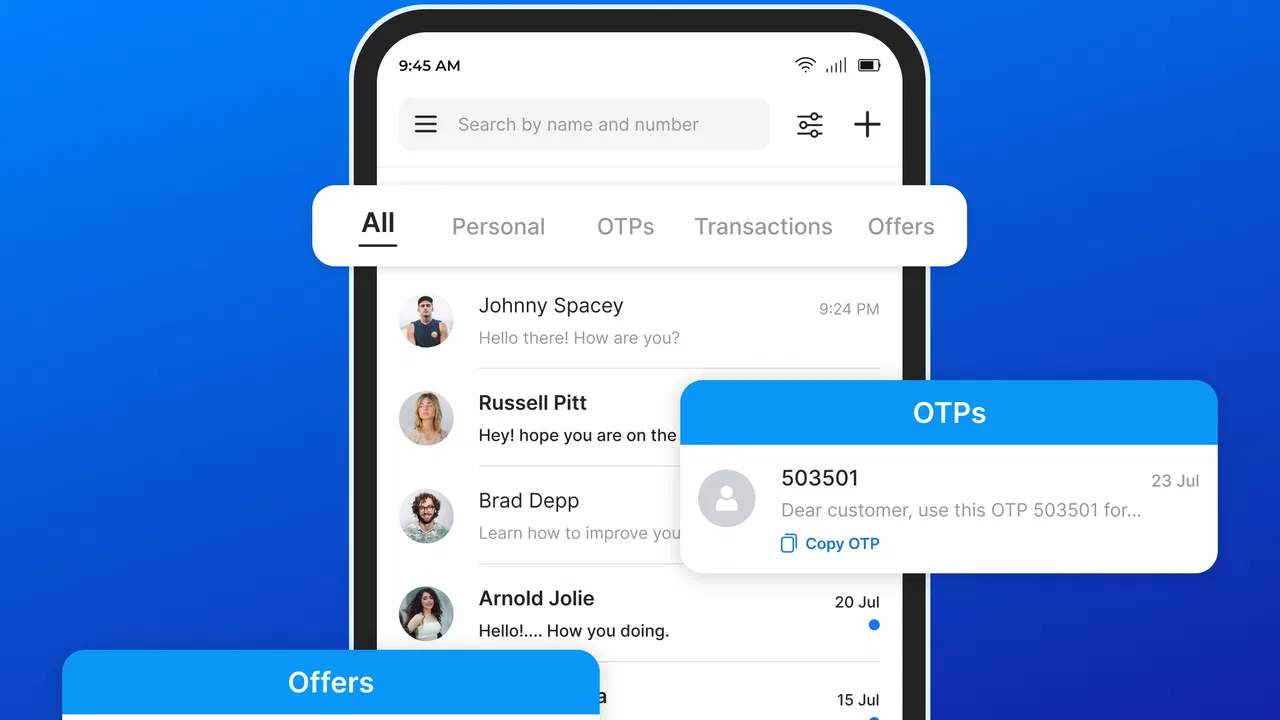
Messages: SMS Text Messenger
- 4.0
- Rating
- 1.00M
- Installs
- Free
- Price

 Analysis by App-foxy
I tend to judge a messaging app by one simple question: does it make everyday texting easier without getting in the way? Messages: SMS Text Messenger takes that focused approach. It is a free communication app from text messages, built around ordinary text messages and instant messaging rather than trying to become a complete social network. After using it as a practical replacement for a standard messaging screen, I found its main appeal is its directness: conversations stay centered on sending and receiving messages.
That narrow focus matters. Many people do not need another platform with profiles, feeds, channels, or a separate account system. They need a familiar place to handle conversations with contacts who may use different phones or different services. This app is aimed at that audience, and its store summary presents it as a private SMS messenger for 2026. I would describe it more simply: it is a straightforward text-focused option for people who want messaging to remain messaging.
A focused text-messaging experience
The app belongs to the communication category, and that description fits better than a broader label such as social networking. Its central capability is the combination of SMS texting and instant messaging in one app. In practical terms, that gives me a single conversation-oriented space instead of forcing me to treat every message as part of a larger online identity.
You May Also Like

 Blood Strike: 2.5 Anniversary
Blood Strike’s Loadouts Turn Every Drop Into a Tactical Gamble
A close look at Blood Strike’s custom loadouts: how fast access to signature weapons reshapes its battle royale rhythm, rewards preparation, and narrows the gap between fights.

 Pandora - Music & Podcasts
Pandora’s Music Is Easy to Start, but Harder to Recover
Pandora’s strength is its low-effort path from a seed to a station. Its weak spot is how much confidence it asks you to place in connection, setup, and quiet recovery.

 8 Ball Pool
 Is Built on Rivalries, Rematches, and Routine
A close look at the rivalries, rematches, shared routines, and unanswered safety questions that turn a quick pool match into a persistent mobile community.

 Samsung Music
’s Quiet Strength Is Playing What You Already Own
Its reach comes less from spectacle than from dependable access to a personal library. That simplicity is both the app’s strongest retention engine and its ceiling.

 AccuWeather: Weather Radar
AccuWeather Review: A Quick, Clear Forecast for Everyday Decisions
For everyday plans, the best forecast is the one you can understand quickly. AccuWeather makes rain timing, radar, and local conditions easy to act on, with a few trade-offs.

 Hill Climb Racing
Why Hill Climb Racing Still Turns Crashes Into One More Run
A tiny car, a bumpy hill and one more upgrade: Hill Climb Racing keeps resurfacing because its simple chaos makes every near-miss feel personal.
More From Our News Desk



The strongest reason to try it is its focused workflow. If your daily conversations are mostly short updates, arrangements, reminders, family messages, or quick questions, a dedicated messenger can feel less distracting than a service built around constant online activity. I can open the app with a clear purpose, find a conversation, write a reply, and leave. That sounds basic, but basic is useful when the goal is reliability and speed rather than entertainment.
The distinction between SMS and instant messaging is also important when choosing this app. SMS is useful for reaching people through their phone numbers and ordinary mobile messaging setup, while internet-based messaging usually depends on an online connection and the recipient using a compatible service. Messages: SMS Text Messenger brings those communication styles into the same general experience, but I would still think about the recipient before deciding how to contact them. A person who expects a specific internet messenger may not receive the same experience here as they would in that service.
I also like that the app is free to install and has an Everyone content rating. That makes it approachable for a wide range of users, including someone who simply wants to try a different texting interface without committing to a paid product. It has passed one million installs and holds a 4.1 average from around 7.9 thousand ratings, which suggests that it has attracted a meaningful audience while still leaving room for mixed experiences.
What the combined messaging approach changes
The real benefit is not that SMS and instant messaging are magically identical. They are not. The benefit is that the user can think in terms of conversations rather than constantly switching between different communication habits. For a person who regularly moves between ordinary texts and internet-based chats, that can reduce the mental friction of remembering which app contains a particular exchange.
There is a useful trade-off here. A specialized messenger can feel cleaner than a large all-in-one platform, but it may not offer the same depth of ecosystem as a service designed around groups, media sharing, communities, or cross-device communication. I would therefore see this app as a practical communications tool first, not as a replacement for every messaging service already on a phone.
How I would use it day to day
My first recommendation is to treat the initial setup as a small decision about habits, not just an installation. If you want this to become your everyday texting screen, use it consistently for a few days instead of switching back after one unfamiliar interaction. The value of a messaging app often appears in the repeated details: how quickly you locate a thread, how naturally you answer, and whether the conversation list remains understandable when several people contact you at once.
A realistic example would be arranging a family pickup. One person sends a short text asking whether the meeting time has changed. I open the conversation, answer with the new time, and continue with my day. Later, another family member asks a related question. The advantage of a focused SMS messenger is that both exchanges remain part of the same kind of task: quick, direct communication. I do not need to open a feed, search through unrelated content, or manage a public-facing profile before replying.
For work, the app can be useful for brief coordination when the conversation does not require a full collaboration platform. A colleague can send a short update, I can respond, and the exchange stays separate from email. I would not use it as a substitute for a project system when messages need formal records, shared files, detailed task ownership, or long-term organization. Its strength is the short conversation, not the structured workflow.
Another practical use is keeping communication simple for relatives who are comfortable with phone numbers but do not want to learn a new social service. The Everyone rating supports that broad accessibility, although ease of use will still depend on the person’s phone, contacts, and familiarity with the messaging style. I would introduce it gradually rather than moving every conversation at once.
Small habits that make the app more useful
One non-obvious advantage of a focused messenger is that it encourages me to separate urgent communication from background noise. I can reserve this app for conversations that deserve a direct reply and leave entertainment or community discussions elsewhere. That separation is especially helpful for people who find large social apps distracting. It does not create extra productivity features by itself; the improvement comes from assigning the app a clear role.
I also recommend deciding which conversations truly belong in SMS and which are better handled through internet messaging. If a contact is likely to be offline, ordinary texting may be the more sensible route. If the exchange depends on a service both people already use, staying there may avoid confusion. The app’s combined approach is most useful when I make that choice consciously instead of assuming every message behaves the same way.
A second useful habit is to keep short-lived conversations short. Texting apps become difficult to manage when every tiny exchange grows into a long chain of unrelated planning. For a temporary arrangement, I would send the necessary details clearly and avoid turning the thread into a substitute for notes or a task manager. That is not a missing feature so much as a realistic boundary: the app works best when I use it for communication rather than storage.
Finally, I would test the app with the people I contact most often before making it my only messenger. Try a normal one-to-one exchange, a reply after a gap, and a conversation that moves between SMS and instant messaging. That quick trial reveals whether the app fits your actual contact habits much better than reading a short description alone.
The best scenario for this app
Messages: SMS Text Messenger makes the most sense for someone who wants a dedicated, uncomplicated place for personal texting. Imagine a user who communicates with a mixture of smartphone owners, people who rely mainly on standard text messages, and contacts who occasionally use internet messaging. That person may appreciate having one focused app to open first, especially if the alternative is jumping between several services.
It is also a good match for someone who dislikes the social pressure attached to larger platforms. There is no need to think of messaging as posting, maintaining a profile, or participating in a community. The experience is closer to opening a digital conversation list and answering people one at a time. For me, that makes it easier to stay purposeful.
The app could also suit a secondary-phone user or anyone who wants to test a different messaging interface without paying. Its minimum operating system is Android 5.0, so it is positioned to work with older Android devices rather than being limited to recent hardware. That does not guarantee identical performance on every phone, but it does make the app relevant to people who are not using the newest device.
I would be more cautious about recommending it to people whose communication depends heavily on large group communities, rich media workflows, business collaboration, or a tightly integrated desktop experience. A conventional internet messenger may be a better choice when everyone in your circle already uses it and relies on its established features. The best app is often the one your contacts already understand and answer promptly.
Where the trade-offs become noticeable
The biggest limitation is the same thing that gives the app its identity: it is focused. If you are expecting a complete replacement for every messaging platform, you may find the experience too narrow. SMS and instant messaging can cover a lot of everyday communication, but they do not automatically provide the culture, tools, or network effects of a mature service built around groups and online communities.
There is also a social trade-off. A messaging app is only as convenient as the people you need to reach. If your friends and family have settled around another service, asking them to change may create more friction than the app removes. I would not switch solely because the interface looks cleaner. I would switch when the app’s focused workflow matches the way my contacts already communicate.
Another point is that “private” in the product description should not make me assume that every privacy expectation is identical to that of a specialist secure messenger. The app is presented as a private SMS messenger, but privacy-sensitive users should still choose communication tools according to their own requirements and the kind of conversation involved. For ordinary personal texting, the focused design may be enough. For highly sensitive communication, I would compare the relevant privacy details of dedicated secure alternatives before deciding.
The combined SMS and instant-messaging idea can also create moments where I need to pay attention to the communication method. A message sent through one route may not have the same delivery conditions as a message sent through another. I would avoid assuming that every contact has the same connectivity, app setup, or response pattern. This is a subtle but important trade-off: one interface can simplify my routine while the underlying message types still behave differently.
How it compares with the usual alternatives
Compared with the default messaging app on a phone, this option is attractive when the built-in experience feels cluttered, dated, or too limited for the way I want to manage conversations. The advantage is not necessarily a dramatic new feature; it is the possibility of a more intentional, dedicated texting environment. If the default app already handles your SMS needs perfectly, the reason to change is weaker.
Compared with large internet messengers, this app feels less dependent on a single social ecosystem. That can be useful when your contacts are not all using the same service. On the other hand, those established alternatives may be better for group coordination, media-heavy conversations, and communities where everyone is already present. I would choose Messages: SMS Text Messenger for direct communication and choose a larger platform when the platform itself is part of the reason people are there.
Compared with a privacy-first messenger, the priorities are different. A privacy specialist may be the better fit for users who place secure communication above convenience and broad SMS reach. This app is more appealing when I want ordinary texting and instant messaging in a simple communication tool, without pretending that one product is ideal for every type of conversation.
Who gains the most from the focused design
The people most likely to enjoy this app are users who want less distraction, communicate mostly through short personal messages, and need a free alternative to their current texting interface. It is especially sensible for someone with an older Android phone, since Android 5.0 is the minimum operating system listed. The app’s current version is 6.1, so users should keep it updated through the normal app-store process when updates are available.
I would also recommend it to someone who wants to experiment without a financial commitment. The price is free, and the Everyone rating makes it broadly approachable. Still, free does not mean universally suitable. A person who needs advanced collaboration, a specific secure protocol, or a deeply established group network should compare alternatives before moving important conversations.
The developer is listed as text messages, and the app has been available since May 26, 2023. Those details place it as a relatively recent choice rather than a long-established default. Its audience size and rating show that people are using it, but I would still evaluate it through my own contact list and daily routine instead of treating popularity as proof that it will fit every phone.
My final recommendation after using it
I see Messages: SMS Text Messenger as a sensible choice for a specific need: keeping personal texting direct, accessible, and separate from the distractions of broader social platforms. Its combined SMS and instant-messaging focus can make everyday communication feel more coherent, particularly when my contacts do not all use the same service.
My recommendation is strongest for short conversations, family coordination, simple personal updates, and users who want a free focused messenger. I would skip it if my main requirement is a feature-rich group platform, a secure specialist messenger, or a complete work communication system. Those are different jobs, and choosing the wrong tool would make the app feel limited.
Used within its proper boundaries, however, it does what I want from a practical communication app: it keeps the path from opening a conversation to sending a reply relatively clear. If your priority is uncomplicated texting rather than a crowded online ecosystem, this is worth trying as your everyday messaging alternative.
FAQs for Messages: SMS Text Messenger
01What features does Messages: SMS Text Messenger offer beyond basic texting?
Messages: SMS Text Messenger provides a variety of features beyond standard texting. Users can enjoy group messaging, multimedia sharing, and customizable themes. The app also supports voice messaging and emojis, enhancing communication. Additionally, it includes a spam filter and message scheduling to streamline user experience and improve privacy.
02Is Messages: SMS Text Messenger compatible with both Android and iOS devices?
Yes, Messages: SMS Text Messenger is compatible with both Android and iOS platforms. This ensures that users can seamlessly communicate across different devices without any compatibility issues. However, some features may vary slightly between the two operating systems, so it's advisable to check specific functionalities for each.
03How secure is Messages: SMS Text Messenger in terms of privacy and data protection?
Messages: SMS Text Messenger prioritizes user privacy by offering end-to-end encryption for messages. This means that only the sender and recipient can read the content, preventing unauthorized access. The app also includes a robust spam filter, reducing the risk of unwanted or malicious messages.
04Does Messages: SMS Text Messenger support multimedia file sharing, and if so, what types?
Yes, Messages: SMS Text Messenger supports multimedia file sharing, allowing users to send and receive photos, videos, audio files, and GIFs. This feature enhances the communication experience by enabling users to share rich media content easily, making conversations more engaging and expressive.
05Are there any costs associated with using Messages: SMS Text Messenger?
Messages: SMS Text Messenger is generally free to download and use, but standard messaging rates may apply based on your mobile carrier's plan. Some premium features may require in-app purchases, so users should review the app's details in the app store to understand any potential costs involved.
Pros
- User-friendly interface with intuitive design.
- Supports multimedia messages
- including images.
- Customizable themes and color options.
- Works offline for saved message access.
- Group messaging feature for efficient communication.
Cons
- No end-to-end encryption for messages.
- Ads can be intrusive in the free version.
- Limited support for third-party integrations.
- Occasional glitches in message delivery.
- Lacks advanced scheduling features.

Messages: SMS Text Messenger
Gallery